

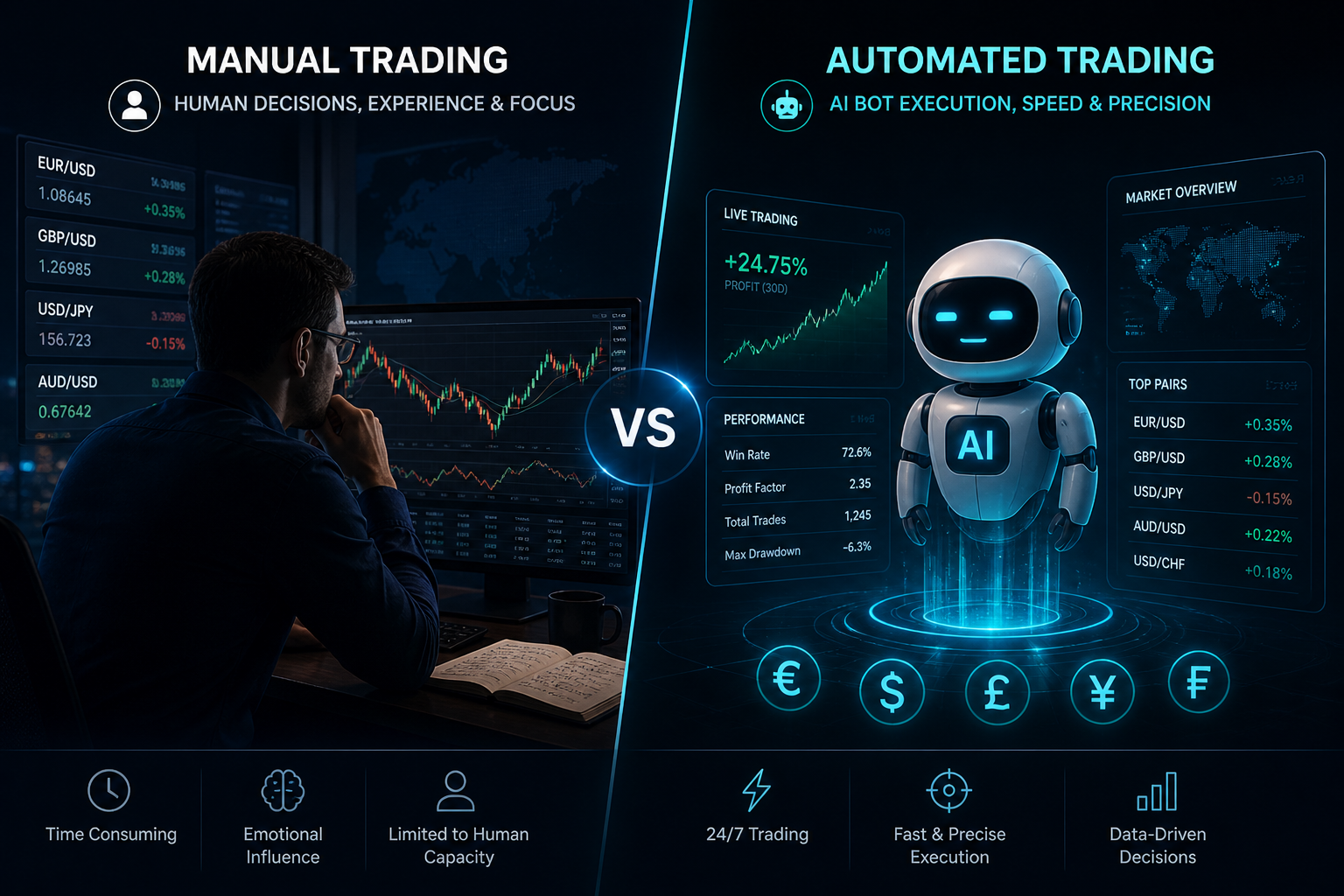
The auto trading vs manual trading forex debate has been going on since the first expert advisor was uploaded to the MetaTrader marketplace. Ask ten traders which is better and you will get ten different answers, usually based on which one they personally use.
We are going to give you a different kind of answer. Not a cheerleading piece for automation, even though that is what we do at OPKEE. An honest breakdown of what each approach actually involves, where each one wins, and who each one is genuinely right for.
Because the truth is, your background, your time, your mindset, and your account size all influence which path makes the most sense for you. Let’s get into it.
What Is Manual Forex Trading?
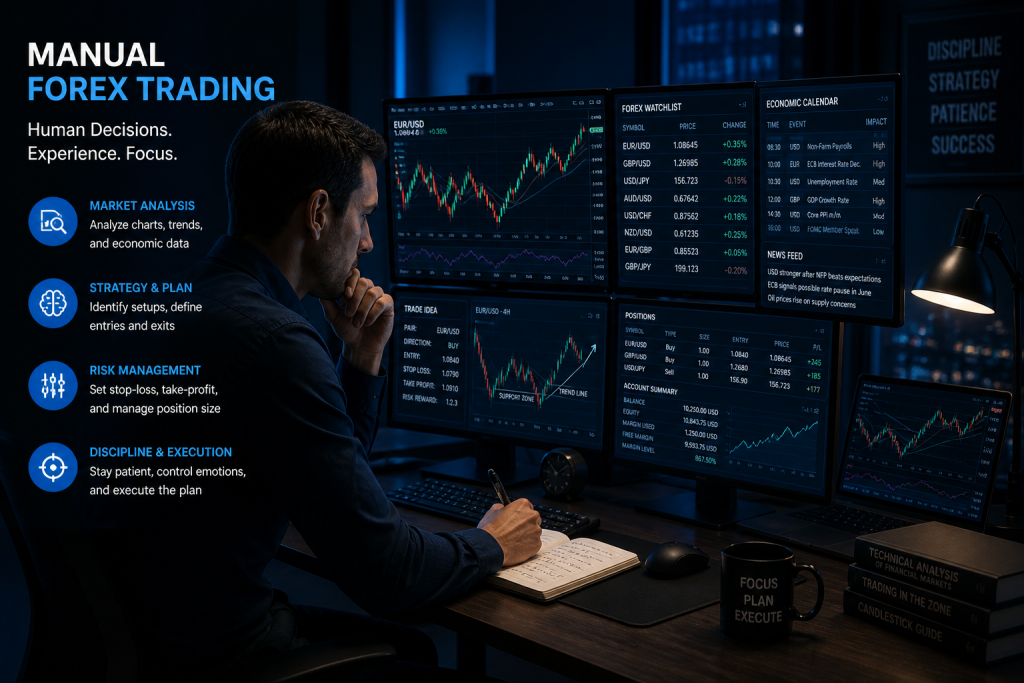
Manual trading means you make every decision yourself. You analyse the charts, you identify a setup, you decide on the entry price and position size, and you place the trade with your own hands. You also manage it in real time, deciding when to move your stop, when to take partial profit, and when to exit.
This is how forex trading worked before algorithmic tools became accessible to retail traders. It still works. Plenty of consistent manual traders are out there making real money. But it comes with requirements:
- Significant screen time, often multiple hours per day
- A deep understanding of technical and sometimes fundamental analysis
- Emotional discipline to follow your rules when the market is moving against you
- Years of screen time before most traders become consistently profitable
Manual trading rewards skill, patience, and obsessive attention to process. If you love the game of trading and genuinely enjoy the analysis, it can be deeply satisfying. But it is not passive, and it is not easy to learn quickly.
What Is Automated Forex Trading?
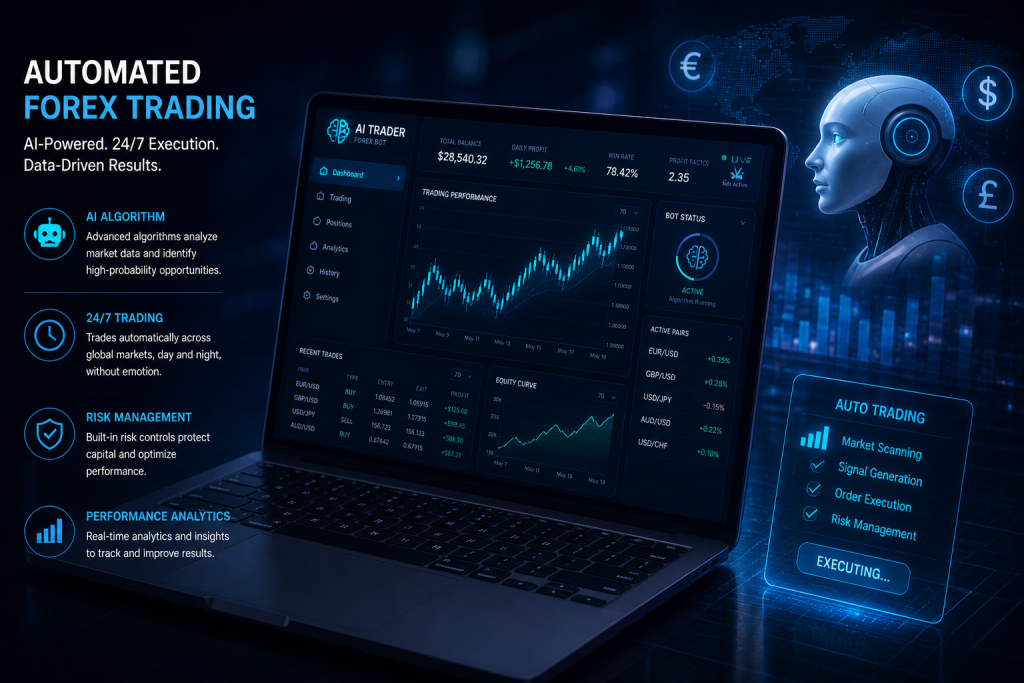
Automated forex trading means a piece of software, known as an expert advisor or forex robot, executes trades on your behalf based on a predefined set of rules. The algorithm reads market data, identifies conditions that match its criteria, and places trades without you needing to watch the screen.
The robot does not get nervous. It does not revenge-trade after a loss. It does not skip a valid entry because it is tired. It executes the same logic repeatedly, at any hour of the day or night.
You still make decisions, just different ones. You choose which EA to run, how to configure it, which broker to use, and what risk settings to apply. Once it is running, the day-to-day execution is handled automatically.
Auto Trading vs Manual Trading: The Direct Comparison
| Factor | Manual Trading | Automated Trading |
| Time required | High: 2 to 6+ hrs daily | Low: setup once, monitor occasionally |
| Learning curve | Steep: months to years | Moderate: hours to days with support |
| Emotional risk | High: fear, greed, revenge trading | None: algorithm follows rules only |
| Consistency | Varies with mood and focus | Same logic every single trade |
| Adaptability | High: reads news and context | Limited unless EA has news filters |
| 24/5 execution | Not possible for most people | Yes: trades while you sleep |
| Best starting capital | Any size, but skill dependent | Works well from $200 upward |
| Right for | Full-time or passionate traders | Beginners, busy professionals, scalers |
Where Manual Trading Still Has the Edge
Let’s be fair. There are situations where a skilled manual trader will outperform any EA:
Reacting to Unexpected News
When a central bank surprises the market with an emergency rate decision, or a major geopolitical event breaks overnight, a manual trader with experience can read the situation and step aside. Most EAs, unless they have a sophisticated news filter, will keep trading straight into the volatility.
Adapting to Changing Market Conditions
An EA is built for specific conditions. A scalping robot optimised for low-volatility range markets will struggle badly in a strongly trending environment. An experienced manual trader shifts their approach instinctively. Most robots need a human to step in and adjust settings when market character changes.
High-Conviction, Macro-Driven Trades
If you understand the economic fundamentals driving a currency pair and want to hold a position for days or weeks based on that view, manual trading gives you complete control over timing, position management, and exit. EAs are generally not built for this kind of macro discretionary trading.
Knowing this, the OPKEE community does not treat automation as a replacement for trading intelligence. We treat it as a tool that handles the repetitive, rules-based execution while humans focus on strategy, selection, and oversight.
Where Automated Trading Wins Consistently
For the majority of people exploring forex for the first time or looking to generate returns without making trading their full-time job, automation has a clear advantage in several critical areas:
- Elimination of emotional trading: the single biggest killer of retail trading accounts is emotion. Automated systems remove it entirely
- 24/5 market coverage: the forex market trades around the clock on weekdays. No human can monitor it all. A robot never sleeps
- Consistency of execution: the same entry and exit rules applied every single trade, whether the market is boring or chaotic
- Scalability: one robot can run on multiple accounts simultaneously, something no manual trader can replicate
- Speed: algorithmic execution happens in milliseconds, which matters enormously for scalping strategies
These advantages are not theoretical. They are why institutional traders have been using algorithmic systems for decades. Retail automation tools simply bring a version of that same approach to smaller accounts.
The Biggest Myth About Automated Forex Trading
Here is the one that trips people up most often: the idea that automated trading means fully passive, zero-effort income.
It does not. Not if you want it to work sustainably.
Even the best EA on the market needs:
- Proper initial configuration matched to your broker and account size
- Periodic monitoring to catch issues before they become expensive
- Settings adjustments when market conditions shift significantly
- Ongoing awareness of which strategies are performing and which are not
The word ‘automated’ means the execution is handled for you, not that you switch it on and walk away forever. The traders who make automation work long-term are the ones who stay engaged with their systems even when they do not have to stare at charts all day.
This is another reason the OPKEE model works so well. Instead of one person trying to monitor multiple EAs across changing market conditions, our community does it together. When something needs attention, the whole group knows immediately.
OPKEE members get weekly live performance updates on every EA and copy-trade system we run. No guessing whether your automation is still working. You will always know.
Which Approach Is Right for You?
Choose manual trading if:
- You have 2 to 4 hours daily to dedicate to chart analysis and trade management
- You genuinely enjoy the process of learning technical analysis and market structure
- You are willing to invest 1 to 2 years building skills before expecting consistent profitability
- You prefer full control over every decision in your trading
Choose automated trading if:
- You want to participate in the forex market without making it a second job
- You are starting with a small account and want consistent, rules-based exposure
- You have tried manual trading and found emotional discipline to be the problem
- You want to grow your account while you learn, not after you have already mastered everything
- You want a community around you that has already tested what works
Most Serious Traders End Up Using Both
Here is what we see consistently across OPKEE members who stick with it: they start with automation, learn how the market works by watching their EA trade, and gradually develop their own discretionary skills alongside it.
The automation generates returns while the education happens. That is a completely different experience from trying to become a profitable manual trader first before you see a cent of return.
You do not have to choose a camp permanently. You just have to choose a starting point that makes sense for where you are right now.
If you are new to forex or have been trying to make manual trading work without success, the smart starting point is a tested, verified automated system. OPKEE gives you exactly that, backed by a community that has done the expensive testing already.
Start Your Automation Journey Without the Guesswork
The OPKEE community was built by traders who lost money the hard way before finding what works. We pooled our resources, tested everything that showed promise, and built a shared vault of verified, live-tested EAs and copy-trade systems.
Joining gives you:
- Immediate access to our EA Vault of tested and verified expert advisors
- Managed copy-trade accounts auto-scaled to your balance
- Weekly live performance reports so you always know what is working
- A beginner-friendly setup process you can complete in under two hours
- A community of real traders who share real results, including the losses
You can start with virtually any account size. You do not need trading experience. You need the right system, properly configured, backed by people who have already proven it works. Learn More.
Skip the hard lessons we already paid for. Join OPKEE today and get straight to the part where your account grows.
Disclaimer: OPKEE Investors is not a financial advisor. All content is for informational and educational purposes only. Trading carries substantial risk of loss. Past performance does not guarantee future results. Conduct your own research before making any financial decisions.